

The Bridge
on knowing

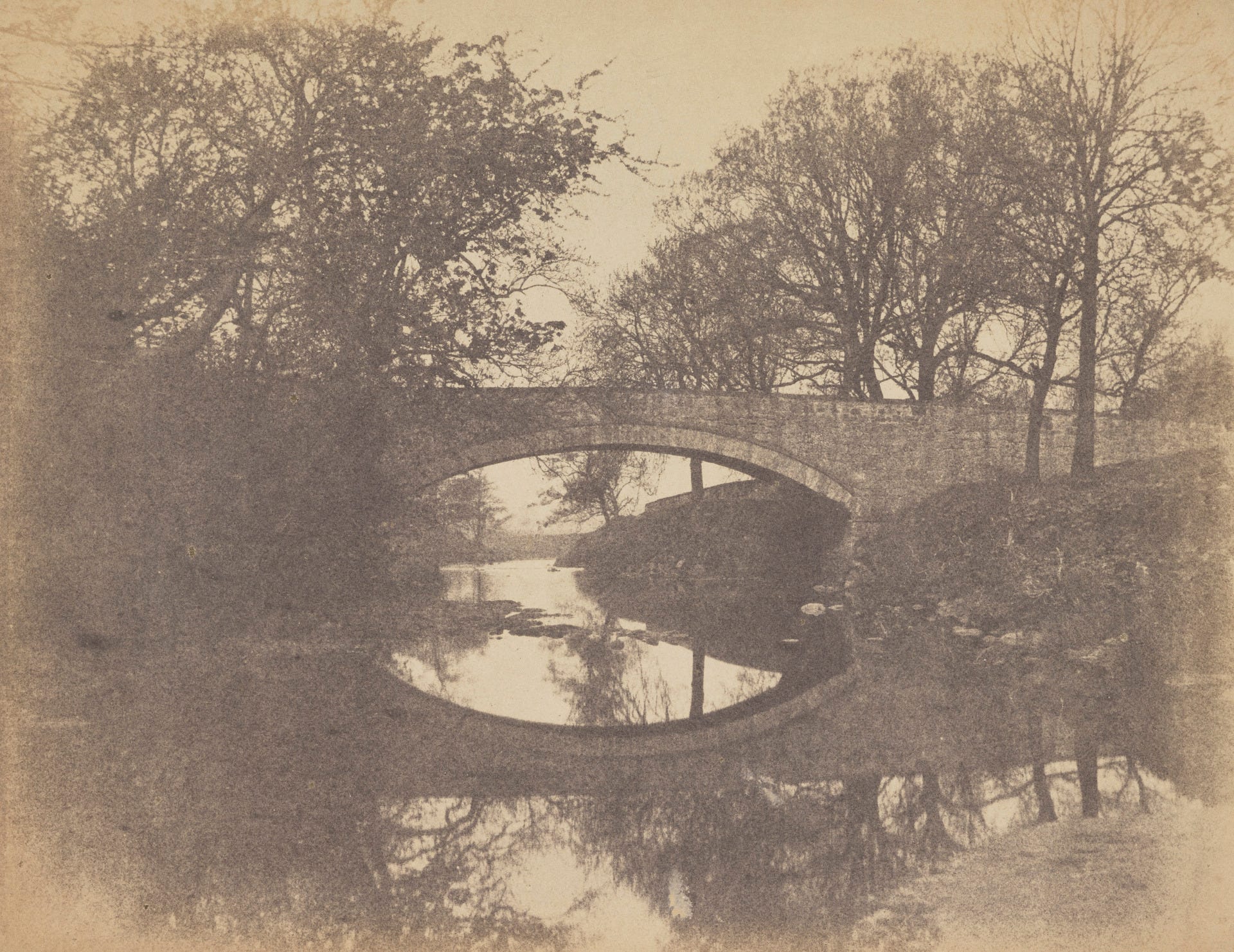
In the sepia haze of the 1850s calotype, the riverbank looks rocky but is held fast by the chiaroscuro of early spring vegetation. I know it is spring because all the branches of all the trees are mostly bare except for their tips, where buds and new leaves are imprinted forever as dark shadow against a parchment sky. The tree that is the same tree in all the photographs rises slimly from the bank next to the old stone bridge, then leans recognisably to the north, toward the unseen hill. In 1904, it still leans but the old stone bridge is gone, now just a smudgy slope of rubble next to the sleek new 1899 bridge made of granite, and in 1969 it is suddenly close enough almost to touch, its bark fissured, the southern face of its leaning trunk scarred as if from pollarding, branches twisting creakily upwards. I think it might be an alder. The bricks from the base of the old 18th century bridge are still embedded in the riverbank here, but the bank itself looks so much more eroded and empty than the previous century, when another calotype taken further upstream shows the bridge behind thickets of scrub that grow prickly against the water. The river is low and slow, offering a blurry mirror image of what must be gorse and hazel predecessors to the plants I know along this stretch today.


I know but I feel unsure about knowing. I switch back and forth between the photographs, comparing the lean of the tree through time. If I am right (and I know I am, but the stakes of being wrong feel stupidly high), then these unnamed calotypes by Scottish photography pioneer John Muir Wood are the earliest photos ever taken of Langside, maybe even of the White Cart Water. Today it’s a dense neighbourhood within Glasgow proper, but then it was just a village, barely a suburb. I knew Muir Wood had photographed the nearby Millbrae House (now long gone), so on a dark day in late winter, I looked through his entire archive held online by the National Galleries of Scotland. I had a hunch that he probably took photos of other things while he was in the neighbourhood. From 800+ images, I plucked a few of bridges that looked promising, and of a watermill that might be the old meal mill. And now I am measuring the proportions of a tree that is certainly the same tree, and highlighting it with big red lines to send to friends, wondering in all caps DOES THIS TREE LOOK LIKE THE SAME TREE TO YOU??
John Muir Wood would have stood in the rocky riverbed to take this photo, so I cannot replicate its angles against the newer photos, taken on the riverbanks, with the exactitude I crave. It’s March 2023, and I have not lived in that neighbourhood for nine months but I cannot stop thinking about it. I have begun the book that will be Lang, a memoir about the largely-forgotten environmental and archaeological histories in this place. Later that year, the proposal will be shortlisted for the Nan Shepherd Prize, and I will finally feel a life-changing sense of validation and recognition of myself as an artist, reborn after my failed years as an academic. But right now it’s still dark in the evenings and the ground is still cold, and I have never found anything like this before. A thing that other local historians don’t know about. A thing that could only have been apparent to someone who had spent years in the shifting, sedimentary time of old maps and old newspapers and repetitive walking, noticing very small things that built up to a bigger picture after many months, about a very specific place that is not very important in the grand scheme of life or even of local history, but that matters deeply anyway. In my new home I have felt far from the land that meant so much to me, even though I can see the Langside hill from my study window. This photo feels like a gift, like the spirit of place raced in an electric current through the ground to make it available to me, specifically. As if we are still communing every day through the movement of the river and the progression of tree buds.
But the idea of being wrong about what I know lurks ominously behind the joyful impulse to share. I have discovered this beautifully intimate thing about this beautifully liminal place, but what if it’s not true? The tree was cut down at some point between the 1970s, when the riverbank was terraced with gabions, and the early 2000s, when the riverbank was excavated and reshaped to build flood defence walls. The distinctive shape is gone, cannot be compared like for like in a way that would convince my most severe inner-critic. What if I expose this discovery to the glare of other people’s fact checking, and something is found that shatters what I feel is certain? What if no one believes me? Would that really matter so much?
~
Within the same month that I find the photographs, I read Fern Brady’s 2023 memoir Strong Female Character. Describing her own lived experience as an autistic queer person, I breathlessly recognise myself. It’s not the first time I have wondered if I’m autistic, but it’s the only time that the research does not dismiss my curiosity with stereotypes of train-obsessed boys and studies focused on cis men. After Brady’s book, I take countless online assessments, download multiple books about women and autism, watch lectures by autism specialists and educators. When I read Unmasking Autism by Devon Price, the certainty of my being autistic feels incredibly, miraculously solid. But like my certainty of the bridge, I am nervous that the evidence I have is not enough to convince others. I lean as carefully as I can into disorienting, sometimes upsetting memories of my childhood and adolescence, charting the topography of my own life through this new lens. Sometimes there is sudden clarity, like looking at the riverbed through a glass; often there is a filmy layer of misgiving and discomfort, and I feel very tired about parsing the mud of my young life, braced for the sharp end of something oddly-shaped. But there are tell-tale trees here too, appearing again and again in enough memories that I am convinced, and my partner is convinced, and my mother is unsure why it took me so long when she suggested it so long ago.
But being sure in myself is not the same as being sure that others will believe me. I am very afraid that this life-changing, life-saving understanding of my brain will be crushed by a key point I’ve missed in all these weeks of self-interrogation. I’m afraid of misrepresenting this condition, of offending people who have a genuine diagnosis. I am not planning on pursuing a formal diagnosis for myself, because I have had enough of the NHS mental health system after pursuing treatment for medical PTSD. I worry that not having a formal diagnosis makes me a fraud. Does it even matter if others know, when I know? Does it fill any useful purpose to say this thing out loud?
Almost as soon as I believe myself, my body unravels. The riverbank erodes. I cannot mask the way I have relied on all these years, cannot process information the way I thought I could before, cannot suppress myself from stimming alone or in public. Suddenly the symptoms are inescapable and frighteningly uncontrollable, as if my body were daring anyone to doubt me.
~
It is a bright cold day and on my phone I am watching author and content creator Rich Pink describe his experience with autistic regression. I’ve been following the videos he makes with his ADHD partner Rox and autistic child Seer for a couple years now, and have felt parasocially invested in his own journey seeking an autism diagnosis. I’m relieved for him that he got the validation he needed, but sad for him that he felt he needed the formality of an official diagnosis in order to retain his authority in making this content. I no longer think that official diagnosis is necessary for everyone who wants to claim that label; I see and experience autism as just one of many marginalised neurotypes that manifest in infinite variations, not as a deficit-based medical condition that requires a doctor’s authoritative recognition. I know now that self-diagnosis is widely embraced by other neurodivergent folk (and, in my experience, not even questioned by medical professionals), and that the process of being formally diagnosed can be discouraging and traumatising in its own right. But right now, in this video, Rich describes very suddenly and bewilderingly losing abilities to communicate and to withstand sensory discomfort that had not troubled him before.
“Before the diagnosis, an adult is unknowingly held together by chronic masking, people pleasing, self-gaslighting, adrenaline, anxiety, and perfectionism, and rigid routines built for survival. A diagnosis can name the problem, validate the struggle, and then the brain removes the pressure that you put on yourself to just push through. Nervous system says, I don’t need to live like this anymore, and that can look like regression. The masking collapsed when the brain no longer deemed it as necessary. The validation allows suppressed needs to surface. And this one’s really interesting: your cognitive load increases. What that means is that you will, all of a sudden after your diagnosis, think back and try and make sense of loads of your life, or feel sorry for yourself and almost grieve in certain ways. And because of that, it takes a lot of your executive function away, so you’re not able to do some of the stuff that you’ve always been able to do.”
At the end he pauses to exhale seriously. “I was a pessimist. But this is real. Hopefully temporary? But I don’t know, maybe this is life now.”
I feel for him. The comments are full of folk echoing what I already know, and what he will ultimately learn: the regression is just the herald for a new way of life. The price of knowing oneself in this way is that the self doesn’t want to be known any other way. I realise in this moment that my last three years have been dominated by the quakes and aftershocks of many surprising “regressions”. After self-belief, I tumbled into a whole new landscape where my body refused to mask or modulate or mimic. I work hard to navigate that landscape as the person I want to be, to communicate myself clearly and honestly, to balance the performance of neurotypicality with the glorious, outrageous grace of processing, creating, and managing in my own time. And it is hard, but only because this new landscape has such a short stratigraphic story, and it is difficult to find parallels or reassurance from other strata of my life, other landscapes that are somehow the same place in me but that have changed so radically.
It has been a couple years since I’ve properly looked at the photos of the old bridge. They feel linked in my mind to that time of self-discovery. Why did I ever feel so apprehensive about the obviousness of this alder? Only, after consulting with people more knowledgable than me, I think it was more likely to be an ash. I offer my past self some compassion; back then, I did not know about the late 19th century photo taken of this original bridge by Glasgow photographer Duncan Brown, which he called, “Bogle Bridge”. (Presumably after the farmer called Bogle who lived at the nearby Papermill Farm all his life.) He took this photo from the western side; I can now match up another of John Muir Wood’s bridge portraits and confirm it’s the same bridge, photographed from both eastern and western viewpoints. (The distinctive ash tree in both these west-side photographs can still be seen on the 2008 Google Street View, clearly an ancient or at least veteran specimen, until it was tragically cut down for the flood wall.)
My eyes prickle with love and awe, unexpectedly moved to see the land so clearly. I do not need to send these photos to friends for double-checking; I know this place. The landscape might be unrecognisable now but I have all the evidence I need.
If you would like to know more about the landscape then vs now, this side-by-side viewer from The National Library of Scotland maps collection will show you where the old bridge and rural farms in the 1850s sat in relation to the new bridge and dense urban environment today.
Thank you for reading. The newsletter remains free for everyone but if you’ve enjoyed it, would you please consider donating to one of the following places:
If you’re in the US and at a loss for how to help, Minnesota Senator Zaynab Mohamed has a list of rent relief/food drive fundraisers that are helping the people of Minneapolis to survive and resist the violent occupation by ICE.
If you’re in the UK, Refuweegee works on the frontline in Glasgow to support refugees and new Scots against escalating racism and anti-immigrant violence; violence that is facilitated by the UK government’s hostile immigration policies and the rise of the far right. The work that Refuweegee do was just profiled beautifully by The Guardian.
This is really lovely, and informative.
Gorgeous.